 Takt Board
Know where every
order is. Right now.
Real-time tracking through every stage of production. Visual workflows that show you exactly what's happening on the shop floor — from raw material to finished product.
Manufacturing is flying blind.
Most manufacturers can't answer a simple question: “Where is Order #1234 right now?” They dig through spreadsheets, call the floor supervisor, or simply guess.
of manufacturers still rely on paper or spreadsheets for production tracking
of total revenue lost to cost of poor quality — scrap, rework, and warranty claims
per hour — the average cost of unplanned downtime in manufacturing
of traditional ERP implementations fail to meet their stated objectives
Spreadsheet chaos
Orders tracked across dozens of files. No single source of truth. One wrong formula and the entire schedule is wrong.
ERPs that don't fit
Traditional ERPs force you to adapt to their rigid workflows. They can't model parallel processes or the way your factory actually works.
Zero real-time visibility
When a customer calls about their order, you walk to the floor, find the supervisor, and get back to them tomorrow. That's not a system — that's hope.
One system. Complete visibility.
Takt Board sits between spreadsheets and bloated ERPs. See every order, every batch, every stage — in real time.
Track
Visual Workflows
Design production workflows that match how your factory actually operates. Parallel streams, assembly points, variable paths — all modeled visually on a canvas.
Trace
Full Traceability
Trace any product back to its raw materials, machines, operators, and vendors. When issues arise, find the root cause in minutes, not days.
Optimize
Actionable Analytics
Machine utilization, operator performance, quality rates, and delivery trends. Dashboards that drive decisions, not just reports.
Built for the shop floor.
Loved by the boardroom.
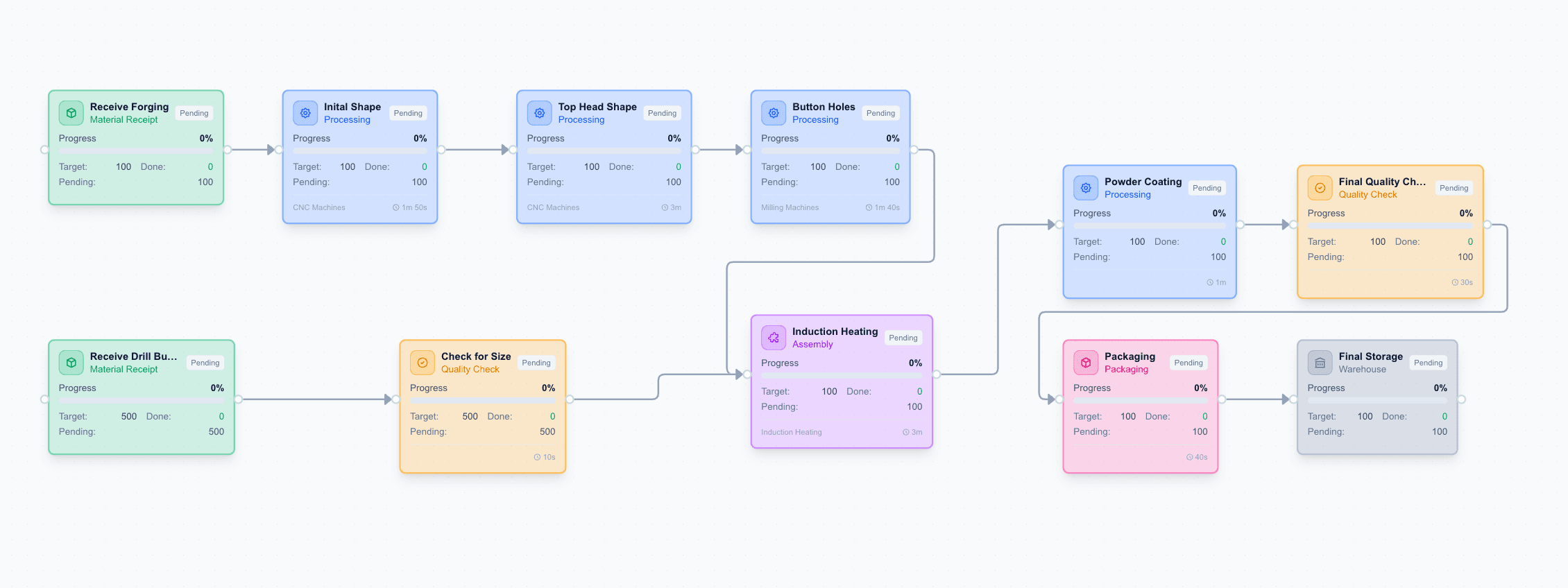
Visual workflow progress — see orders flow through production
The heart of Takt Board. Design your production workflow once, then watch every batch flow through it in real time. Parallel material streams converge at assembly points. Progress bars show exactly how far each stage has come.
- ✓Answer "where is my order?" in seconds, not hours
- ✓Identify bottlenecks before they cascade into delays
- ✓Support parallel processes, assembly, and variable workflows
- ✓Color-coded stages: complete, in-progress, blocked, not started
Scan. Track. Trace. Down to the individual piece.
Every piece or bin gets a QR code. Scan at input, scan at output. The system captures the operator, machine, timestamp, and batch — automatically. No manual entry. No errors.
- ✓Eliminate manual data entry errors on the shop floor
- ✓Piece-level or bin-level precision — you choose
- ✓Complete assembly lineage: know which components went into each product
- ✓Narrow recall scope from entire batches to specific units
Numbers that tell you what to fix — and what's working
Efficiency, quality, utilization, productivity — tracked per machine, per operator, per shift. Trend lines reveal whether you're improving. Breakdowns reveal where the problems hide.
- ✓Machine utilization and OEE metrics at a glance
- ✓Operator performance with skill analysis and consistency scores
- ✓Quality rate tracking: produced, rejected, and rework units
- ✓Shift-over-shift and day-over-day trend analysis
Schedule production with confidence, not guesswork
Drag-and-drop scheduling across machines, shifts, and time blocks. The system knows cycle times, machine availability, and current load. It prevents double-booking and shows you free capacity.
- ✓Visual calendar and Gantt chart planners
- ✓Automatic conflict detection for machine schedules
- ✓Cycle time-based duration estimation from part master data
- ✓Schedules feed directly into production sheets for operators
Everything you need.
Nothing you don't.
Visual Workflow Designer
Model how your factory actually works — parallel streams, assembly points, and custom paths. Drag, drop, done.
Real-Time Order Tracking
Know where every batch is, right now. Live progress bars, status indicators, and instant bottleneck detection.
QR Code Traceability
Scan at every stage. Trace any product back to its raw materials, machines, and operators in seconds.
Digital Production Sheets
Replace paper logs forever. Operators log quantities, quality, and notes — structured and searchable.
Smart Scheduling
Drag-and-drop calendar with conflict detection. Schedule by machine, shift, and time block.
Production Analytics
Efficiency, quality, utilization — per machine, per operator, per shift. Spot trends. Fix what matters.
Inventory & BOM
Track materials, auto-calculate batch needs, and get low-stock alerts before production stalls.
Multi-Location & Roles
Multiple factories, eight role levels. Everyone sees exactly what they need — from operators to the CEO.
Live in four steps.
No six-month implementation. No consultants. Define your reality, and start tracking.
Define your masters
Add your machines, operators, parts, materials, and locations. This is the vocabulary of your factory.
Design your workflows
Use the visual workflow designer to model how each product is made — including parallel streams and assembly points.
Create orders & batches
Enter orders, split into batches, attach workflows, and optionally set up QR tracking for fine-grained traceability.
Track everything
Operators log production via digital sheets or QR scans. You see real-time progress, analytics, and traceability — instantly.
Everyone sees what they need.
From the shop floor operator logging production to the CEO checking delivery timelines — each user gets exactly the view they need.
Factory Owner
High-level dashboards, KPIs, delivery timelines, and bottleneck identification. See if the business is on track at a glance.
Production Manager
Real-time floor view, machine utilization, order progress, and daily production reviews across all machines and shifts.
Planning Team
Capacity planning, machine scheduling, workload balancing, and forward visibility into what's coming next.
Shop Floor Operator
Simple production logging — scan QR codes or fill digital sheets. See assigned work for the shift. Minimal friction.
Quality Team
Inspection checkpoints, pass/fail recording, defect tracking, and complete traceability for root cause analysis.
Sales & Customer Service
Instant order status. Know exactly where a customer's order is and when it will ship — without calling the factory floor.
The right tool for the job.
Spreadsheets are too fragile. Traditional ERPs are too rigid. Takt Board is the structured, flexible middle ground.
Spreadsheets
Where most start
- ✓Flexible
- ×No structure
- ×No analytics
- ×Doesn't scale
- ×No traceability
- ✓Cheap
Takt Board
Just right
- ✓Flexible
- ✓Structured
- ✓Built-in analytics
- ✓Scales with you
- ✓Full traceability
- ✓Right-sized cost
Traditional ERP
Overkill for most
- ×Rigid workflows
- ×Over-structured
- ×Complex reporting
- ×Expensive
- ×50-70% fail rate
- ×6-18 month setup
The cost of not knowing.
Every day without real-time visibility is a day of waste, missed deliveries, and quality problems you can't trace.
to cost of poor quality — scrap, rework, warranty, and recalls. Without traceability, you can't find where the waste is hiding.
Source: ASQ ↗The labor shortage means you need every operator working efficiently. Systems must reduce manual work, not add to it.
Source: Deloitte ↗Most factories operate at 60% effectiveness. World-class is 85%. The gap is worth millions in lost capacity.
Source: OEE.com ↗after just one late delivery. On-time delivery rates of 75-85% are the norm. Real-time tracking changes that.
Source: Hollingsworth ↗Common questions.
How long does it take to set up?+
Do we need QR scanners or special hardware?+
Can it handle our complex, non-linear workflows?+
How is this different from an ERP?+
What if we already use spreadsheets or an ERP?+
Is our production data secure?+
Stop guessing.
Start seeing.
Every minute you spend searching for order status, chasing production updates, or investigating quality issues is a minute Takt Board could save.